Six of Swords
- Upright
- transition · gaining distance · journey
- Reversed
- clinging on · unresolved baggage
The crossing into calmer waters.
Meaning
The Six of Swords shows a transition. You have left something difficult behind and are on your way to a calmer place, even if you have not arrived yet. In the suit of Swords the Six is the point at which the mind stops fighting and starts looking for a way. The air grows clearer and thinking becomes reliable again, but the mood is quiet, almost melancholy. You don’t sail away cheering; you simply go.
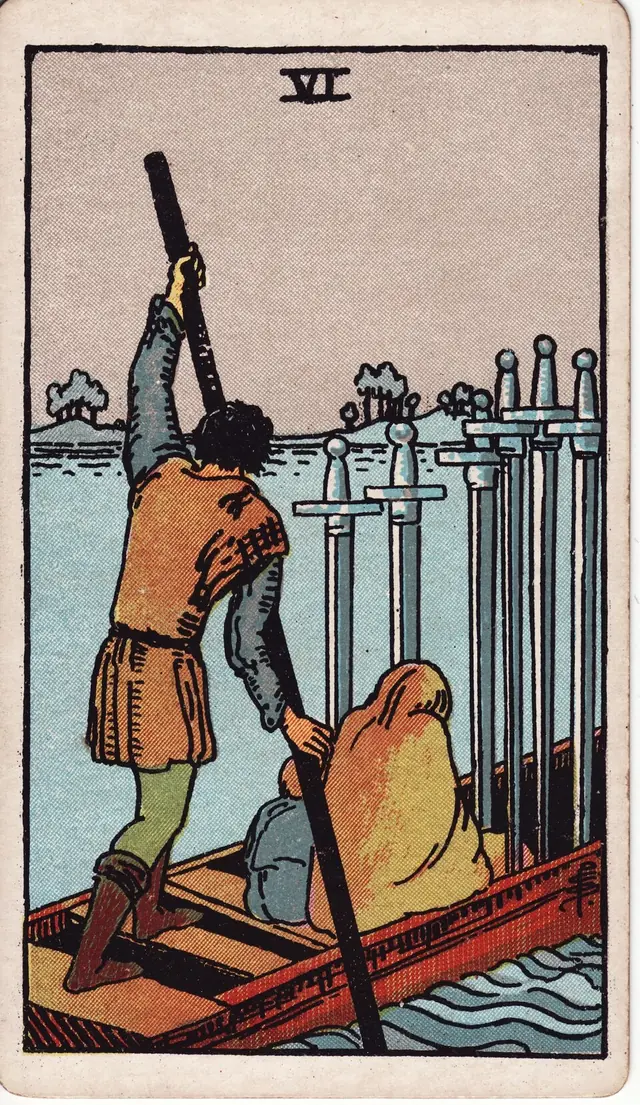
In life this card shows up with house moves and job changes, after separations, when moving away from a town or when inwardly saying goodbye to a conviction. Often you take someone with you or are accompanied yourself, and often you don’t yet know exactly what the other shore looks like. The swords in the boat show that the experiences travel with you; they are not denied, but they no longer steer.
The card invites you to let yourself be ferried across without constantly looking back. Not every movement has to feel like a new departure. Sometimes it is enough to know the direction and stay sitting quietly while the water settles. Ask yourself what you are taking with you and what you can leave on the old shore.
Advice: Let yourself be ferried across and look ahead.
Reversed
Reversed, the crossing stalls. You want to leave but can’t get away, because old baggage holds you back: unfinished conversations, guilt, fear of the unknown. Perhaps you also turn back just before you reach the new shore, because the old one is at least familiar. The card then shows a back and forth in which a great deal of strength is lost.
A second reading: the journey does take place, but you are taking too much with you. The boat sits low in the water because you don’t want to leave behind a single story, grudge or habit. Reversed, the Six of Swords invites you to check what is really holding you. Sometimes it is a conversation that is still missing, sometimes only your own permission to go.
Love and relationships
In relationships the Six of Swords shows that you are moving out of a difficult phase together: the crisis is not forgotten, but it no longer shapes every day. It can also be the quiet process of coming to terms with a separation, in which the pain still travels with you but grows quieter. If you are single, the card often means that you are leaving old patterns behind and slowly opening up again, without haste.
Work and money
At work the Six of Swords stands for a change: a new position, a different location, the move into a calmer area of responsibility or the end of a stressful project. The change is less spectacular than it is necessary. With money, it can mean that you are leaving a difficult phase behind and the situation is slowly stabilising. Plan the transition soberly and get advice where you need it.
As the card of the day
Today is about movement without drama. Take one step that leads you away from an old situation: drafting a letter giving notice, packing a box, ending a conversation that keeps going round in circles. Don’t keep looking back. If you need company, accept it. And let the water behind you grow calm instead of stirring it up.
The image
We see a ferryman from behind, punting a flat boat through the water with a long pole. He wears a brownish-orange waistcoat, grey sleeves and green hose. In front of him in the boat sits a figure wrapped entirely in a yellowish-brown cloak, and beside her a child in grey. Six swords stand upright in the bow, as if they were part of the cargo that has to come along. The water to the right of the boat is choppy and rippled; to the left, where the journey is heading, it lies smooth. Trees stand on the far shore, and the sky is pale and grey. No one speaks, no one looks back. The swords are the experiences you cannot simply put down, but can carry towards a calmer shore.
Questions for you
- Which shore are you travelling away from right now, and where do you want to arrive?
- Which experiences are travelling with you, and which of them are by now just ballast?
- Who or what helps you to see the crossing through?