Five of Swords
- Upright
- conflict · pyrrhic victory · defeat
- Reversed
- reconciliation · letting go
You won, but at what price?
Meaning
The Five of Swords shows a conflict that has been decided but has resolved nothing. Someone has won, someone has walked away ashamed, and the air is still charged. The Five brings friction and loss into every suit; with the Swords this happens through words, arguments and positions. It is about quarrels in which, at some point, the issue itself no longer matters, only who is left standing at the end.
You know the situation from both sides. Sometimes you are the one with the swords: you were right, you got your way, and still it feels hollow, because you destroyed something in the process. Sometimes you are one of the two who walk away, humiliated, passed over, angry. And sometimes you stand on the sidelines and watch others tear each other apart.
The card invites you to weigh up the costs and benefits of a fight honestly. Not every argument is worth having, and not every victory is a victory. Ask yourself what matters more to you: being right or keeping the relationship. Sometimes walking away is the wiser form of strength.
Advice: Ask yourself whether this fight is worth it.
Reversed
Reversed, the Five of Swords shows the chance to step out of the quarrel. The swords are put down, a conversation becomes possible, an apology finally gets spoken, or you realise that being right has cost you more than giving in would have. Reconciliation does not have to mean that everything is fine again; often it is enough not to carry on fighting.
Reversed, however, the card can also show that a conflict is still having an effect: resentment that remains unspoken, or the fear of losing again, which is why you avoid every confrontation. Then it invites you to look at what you are still carrying around with you and to consider whether you want to let it go or finally raise it. Either is better than carrying on fighting in secret.
Love and relationships
In love the Five of Swords stands for arguments in which words are used as weapons, for power games or the feeling that one of you always has to win. After a fight like that, even the winner feels alone. In a partnership it is worth asking what it is really about when you fall out over the same thing for the third time. If you are single, the card can point to a dynamic in which you let yourself be made small, or make yourself small.
Work and money
At work the Five of Swords shows rivalry, intrigue or a tone in the team where everyone looks out only for their own advantage. Sometimes it is wiser to withdraw from such a conflict than to try to win it at any price. With money, the card warns against deals in which someone gets ripped off, even if it isn’t you. Check contracts carefully and make your own decisions.
As the card of the day
Today there may be friction, and you will be tempted to have the last word. Pause briefly before you say it. Ask yourself whether it will still matter tomorrow who won. If someone provokes you, you don’t have to play along. A step to the side is not a defeat today, but the smartest move on the board.
The image
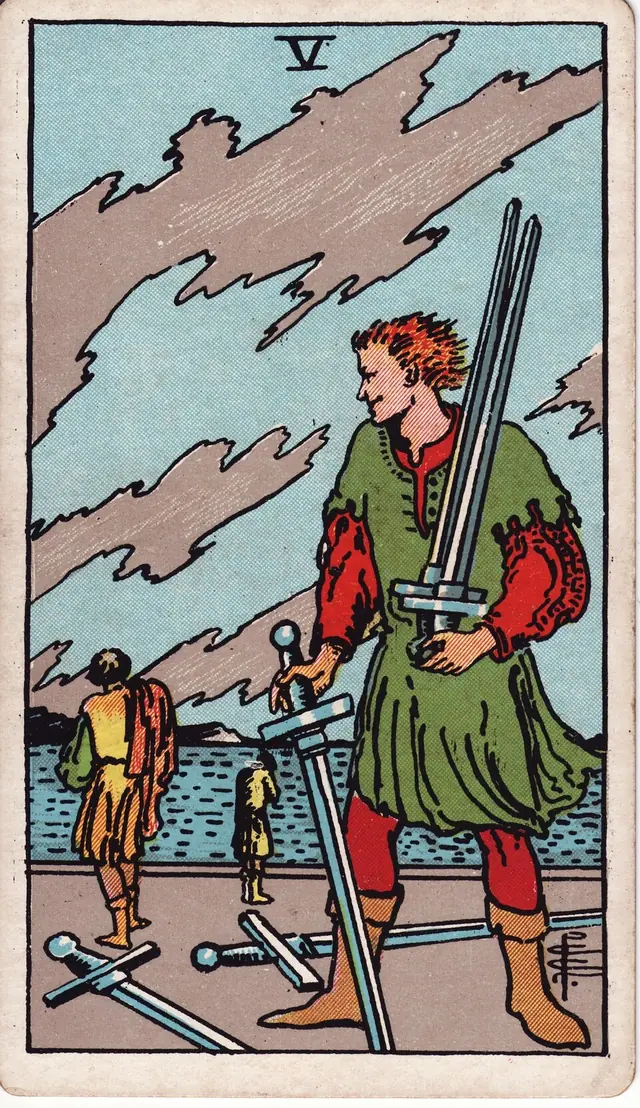
A young man with tousled red hair stands in the foreground with two swords over his shoulder, just picking up a third from the ground. He wears a green tunic with red sleeves, red hose and brown boots, and looks back over his shoulder with a thin, satisfied grin. Two more swords lie in the dust in front of him. On the shore two figures are walking away: one with a bowed head and a red cloak, a smaller one turning towards the water. Above them ragged grey clouds drift across a pale blue sky, as if a storm had only just ended. The winner has all the swords, but no one stays with him. The water behind the losers stands for the feelings left behind after a quarrel like this.
Questions for you
- Which fight are you having right now, and what would it cost you if you won it?
- Where do you really just want to be right, even though you claim it is about the issue?
- Which battlefield would it be time to simply walk away from?