Ten of Wands
- Upright
- burden · responsibility · overload
- Reversed
- letting go · delegating
Too much on your shoulders.
Meaning
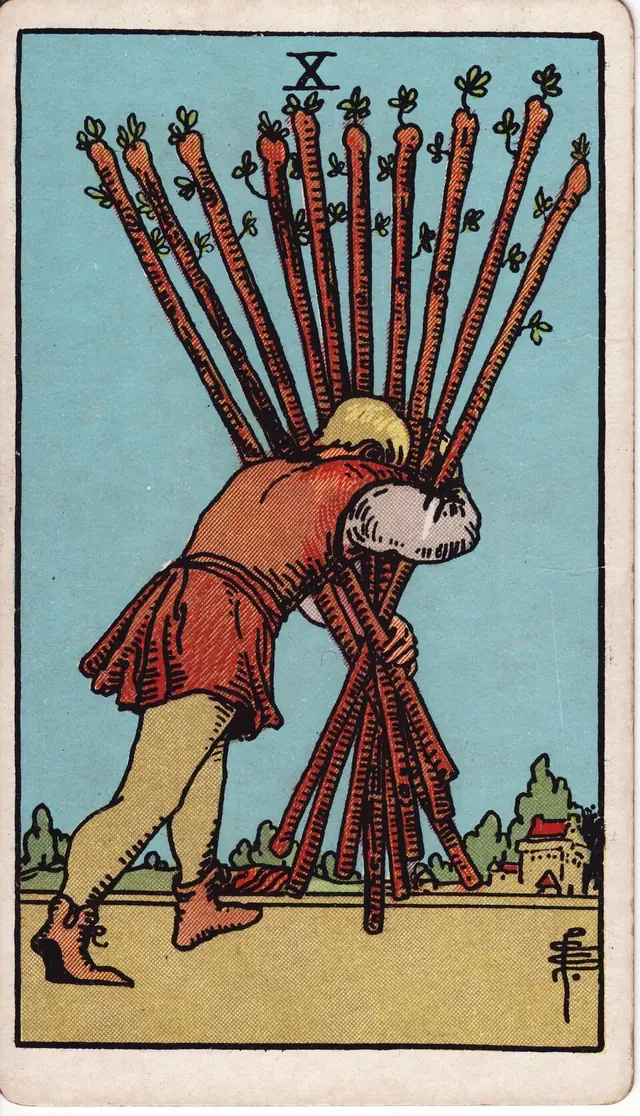
The Ten of Wands shows the point at which Fire becomes a burden. What began as a spark and grew through planning, contest and speed now lies in its full weight in your arms. As the last numbered card of the sequence, it brings the consequence of enthusiasm without limits: you have taken on too much, promised too much, carried too much on your own. The goal is close, but the way there is spent bent double.
In life it shows up in overtime, in responsibility nobody else wants to take on, in the feeling that everything will collapse if you let go. Often there is a pattern behind it: you say yes because you can, and only realise later that being able to and having to are not the same thing. A sense of duty, perfectionism and a reluctance to ask for help also belong to this card. The burden is real, but how it is shared out is a decision.
The Ten of Wands invites you to stop and sort through the bundle. Which of it really belongs to you? What could someone else carry, what could wait, what could simply be left where it is? Ask yourself whether you took the load on in order to be needed, and what would happen if you handed part of it over. Probably less than you fear.
Advice: Put down what isn’t yours.
Reversed
Reversed, you put things down. You recognise that part of the burden was never yours, you delegate, say no or let go of a venture that was only wearing you out. That can be liberating, sometimes embarrassing too, because you notice how long you have been dragging it around for nothing. The reversed card can also show the opposite: an overload that nobody sees any more, responsibility that is pushed onto others, or a collapse because nobody redistributed the load in time.
Turned inwards, it is about what you feel responsible for without actually being so. Ask yourself which burden you carry out of habit, and whether you allow yourself to set it down before it forces you to.
Love and relationships
In love, the Ten of Wands shows overload and unevenly shared responsibility: one person carries the everyday life, the organising, the emotional work, and the other barely notices. If you are single, it can mean you are hauling so much that you have no strength left for meeting people. In a relationship the card invites you to say openly what has become too much, before the relationship itself is felt to be nothing more than a duty. Sharing burdens also means showing trust.
Work and money
At work, the Ten of Wands stands for overtime, too many projects at once, tasks nobody takes off your hands, and the feeling that the pile will never get smaller. Prioritising matters more now than holding out. With money it can show commitments that have added up, or a venture that eats up more effort than it gives back. Get an overview, talk to the people responsible and check what you can hand over or bring to an end before you decide.
As the card of the day
As your card of the day, the Ten of Wands invites you to hand over, postpone or cross off at least one task today. Write down everything you are carrying, and mark which of it is really yours. Ask someone for help, even if that feels unfamiliar. The day is not there for getting more done, but for arriving more lightly.
The image
A fair-haired man trudges to the right, bent low, clutching a bundle of ten wands to his chest. The wands fan out in front of his face and block his view; his head almost disappears between them. He wears an orange-red tunic, pale hose and brown shoes, and his posture is strained to the point of cramp. The ground is yellowish brown and level, the sky blue. In the background on the right, not far away, a house with a red roof stands among trees, evidently his destination. The way he carries the wands shows how awkward he has made the load for himself: they could be bundled, shouldered or brought in two trips. The nearness of the house and his blocked view together tell us that he is almost there and cannot see it.
Questions for you
- What are you carrying right now that really belongs to someone else?
- Why do you find it hard to ask for help or to say no?
- How close are you to your goal, and can you still see it for all your tasks?