Ten of Swords
- Upright
- ending · rock bottom · collapse
- Reversed
- recovery · new beginning
The end, final, and beyond it the morning.
Meaning
The Ten of Swords shows an ending that leaves no more room for doubt. A situation, a hope, a role or a story you have been telling yourself about your life lies on the ground. As a Ten, the card completes the suit of Swords: thinking has come to the end of its road, all the arguments have been exchanged, nothing is left to explain. That is painful and at the same time a relief, because the uncertainty is over.
In everyday life you meet this card when a project finally fails, when a relationship ends and no one pretends any longer, when a conviction collapses, or in moments when you catch yourself making the drama bigger than it is. Ten swords are a lot. Sometimes the card is also a hint that you have settled into your defeat.
The Ten of Swords invites you to acknowledge the ending without glossing over it and without losing yourself in it. The horizon on the card is bright. Ask yourself what has really ended, what you have learned from it, and what you want to do first when you get up, now that there is nothing left to defend.
Advice: Acknowledge the ending and get up.
Reversed
Reversed, recovery begins. The swords come loose, you pull yourself up, and what looked like a collapse turns out to be a turning point. Sometimes the reversed Ten also shows that a feared ending does not happen or is less final than you thought. The night was long, but it is over.
Reversed, however, it can also mean that you don’t want to accept an ending. You cling to something that is long over, revive projects or relationships that have no future, and so prolong the pain. Or you cultivate the role of the victim because it guarantees you attention. The card invites you to get up. Not because it didn’t hurt, but because staying down is no solution.
Love and relationships
In love the Ten of Swords shows an ending with no back door: a separation that is final, a breach of trust after which nothing is the same as before, or letting go of a relationship that has long existed only on paper. That is bitter, but it makes room. If you are single, the card can mean that an old story may now be closed for good. Only then is there space for something new.
Work and money
At work the Ten of Swords stands for the failure of a project, the loss of a job or the end of a collaboration, where it is clear that there is no way back. Hard as that is: with the ending, the fight ends too. With money, the card can point to a low point from which the situation can be put back in order. Get an overview, get advice and plan the fresh start soberly.
As the card of the day
Today is about closure. Finish something you have left half open for too long: a file, a conversation, a chapter. Don’t make a drama of it, and don’t play it down either. Name what is over, and then look consciously towards the horizon. What is the first thing you want to do after this ending?
The image
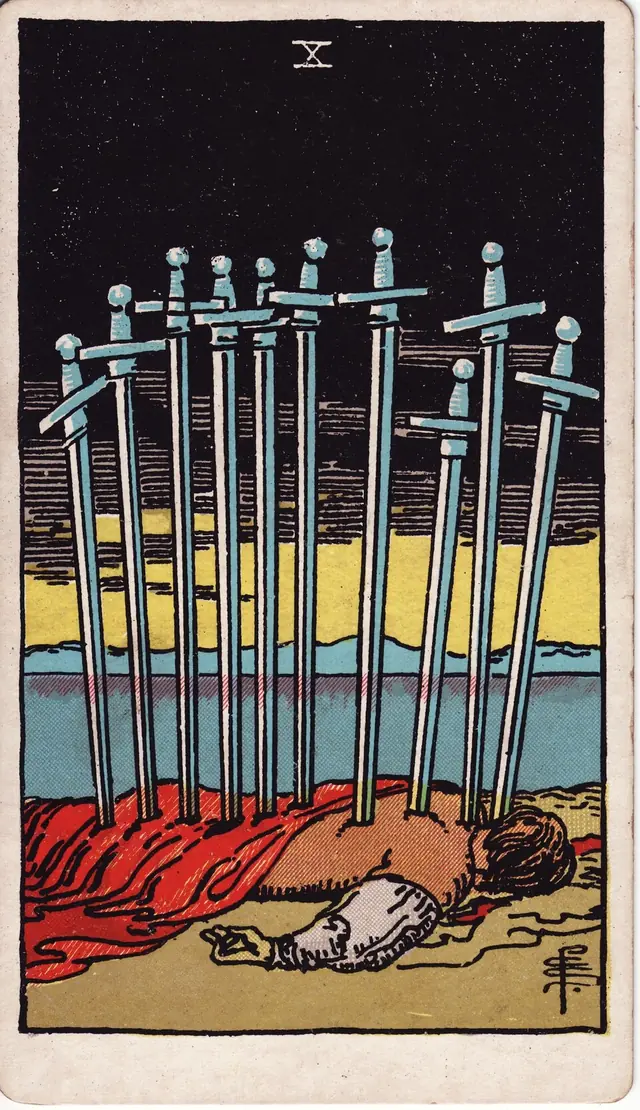
A figure lies face down on the shore of still water, covered by a red cloak, and ten swords are stuck in a row in the figure’s back, from the head down to the hip. The hand on the ground forms a calm gesture, two fingers extended, like a sign that something has been let go. The sky above the scene is black, but on the horizon it is turning yellow: over the water and the blue-grey mountains a new day is beginning. The picture on the Waite-Smith card exaggerates on purpose. One sword would be enough for an ending; ten are drama, escalation, the point at which things cannot get any worse. That is exactly where the message lies: it is over, completely, and behind the darkness the light is already on its way.
Questions for you
- What in your life has really come to an end, and where are you only pretending it is still open?
- Which ending have you made more dramatic than it needs to be?
- What becomes possible as soon as you close this chapter for good?