Queen of Pentacles
- Upright
- nurturing · groundedness · wellbeing
- Reversed
- neglect · overload
Care with both feet on the ground.
Meaning
The Queen of Pentacles embodies the Earth suit in its most mature, nurturing form. She has understood that prosperity only makes sense if it does people good: herself, her family, those around her. She is practical, generous, physically present and connected with everything that grows. With her, sensuality and reliability belong together.
As a part of your personality, she shows the side of you that cares for others without losing yourself in the process. You look after household, body, finances and relationships with the same seriousness, and you know that a laid table and a paid bill can be forms of love. Typical situations: you are responsible for the wellbeing of others. You are building a home, a garden, a business in which people feel well looked after. Or you are learning right now to look after yourself as well as you look after everyone else.
As a person around you, the Queen is someone with whom you can feel at home: down to earth, warm, with a fine feel for the practical. She gives advice that stands with both feet on the ground. The card invites you to value this quality and to ask where care is needed right now, including from you for yourself.
Advice: Look after yourself as well as you look after others.
Reversed
Reversed, the care tips over. The Queen looks after everyone except herself, until exhaustion and resentment creep in. Or she clings to the material, measuring affection in gifts and control in household matters. The card can also show that body, home or finances are being neglected, because the strength is lacking or because you don’t trust yourself to look at them.
Turned inwards, the reversed Queen often describes the belief that you are only valuable when you are needed. Ask yourself who looks after you once you have looked after everyone else, and whether you allow yourself to sit on the throne yourself.
Love and relationships
In love, the Queen of Pentacles stands for emotional security, reliability and sensual closeness. In a partnership, she shows a bond in which everyday life, the body and care naturally belong together; she invites you to live out affection in concrete gestures and to accept it in that form too. If you are single, she can herald someone who is warm and down to earth, or remind you to be a home for yourself first before you share one.
Work and money
At work, the Queen of Pentacles stands for organisation, sustainability and work that takes care of people: nursing and care, administration, hospitality, farming, leadership that looks after its people. She shows an environment in which thoroughness and warmth come together. Where money is concerned, she stands for wise, thrifty housekeeping and for generosity in moderation. How you use your resources remains your responsibility; the card reminds you not to lose sight of wellbeing as you do so.
As the card of the day
As the card of the day, the Queen of Pentacles invites you to take good care of something living today: a person, a plant, your body, your home. Cook something proper, tidy up a spot where you want to feel at ease, ask someone how they are and listen. And give yourself one gesture of care that is just for you. Today, both belong together.
The image
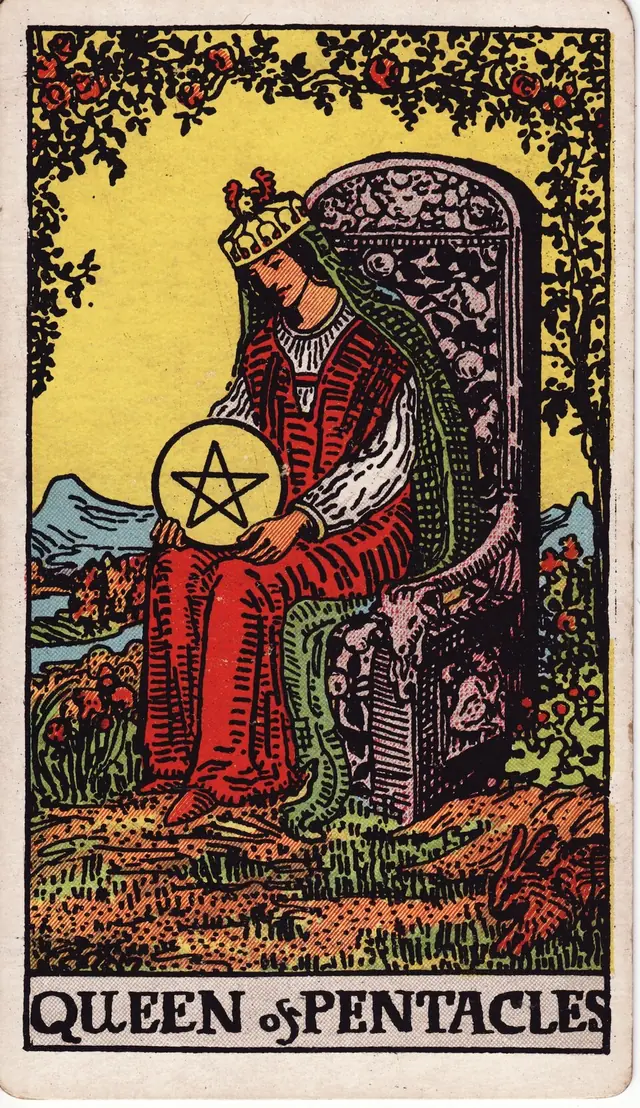
The Queen sits on a heavy grey stone throne carved with fruit, foliage, a goat’s head and childlike figures. Above her arches a bower of rose branches with red blossoms. She wears a red robe with white sleeves, a green veil over her head and shoulders, and a golden crown. With both hands she holds a large golden coin with a pentagram in her lap and looks down at it attentively. On the left, blue mountains rise above a river; the sky is yellow, the ground reddish-brown and overgrown with grasses and red flowers. At the bottom right, a hare hops past. The Queen sits in the midst of nature, not above it. The coin in her lap shows that she treats possessions as something living, something to be held and cared for, not hoarded.
Questions for you
- Who am I caring for right now, and who is caring for me?
- How do I treat my body, my home and my money: as something living or as a burden?
- Where could I bring warmth and practicality together today?