Six of Wands
- Upright
- victory · recognition · success
- Reversed
- pride · lack of recognition
The victory is seen.
Meaning
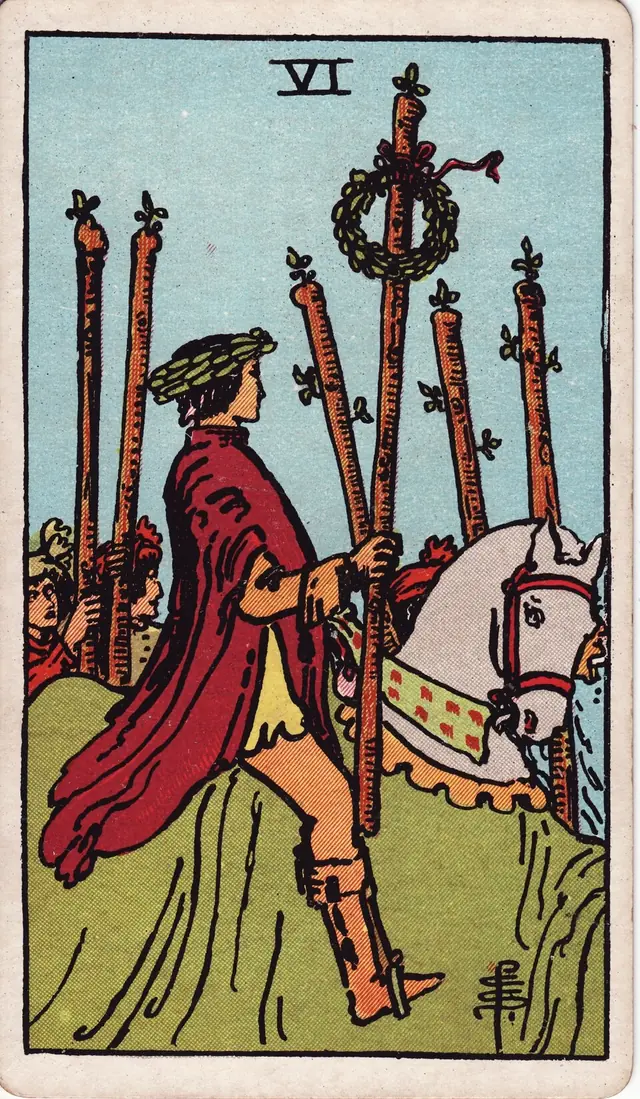
The Six of Wands shows the moment when effort is visibly rewarded. You have prevailed, passed a test, reached a goal, and this time other people notice too. As the sixth card of the Fire sequence, it brings order to the scuffle of the Five: competition has turned into a decision, friction into a result. The laurel is deserved, and the crowd walking with you confirms that you have not won only in your own eyes.
In life the card stands for promotions, passed exams, contracts won, applause after a performance, but also for quieter forms of recognition: honest praise, trust that someone expresses in you, the experience that your efforts have been seen. It touches on the question of self-worth and how you come across to others. Success that nobody notices feels incomplete to many people, and that is only human.
The Six of Wands invites you to accept the moment without playing it down and without resting on it. Take the wreath, thank those who came along with you, and ask yourself where you will ride next. Recognition is a tailwind, not a goal. It carries you furthest when you share it.
Advice: Accept the laurels without resting on them.
Reversed
Reversed, the applause fails to come, or it feels wrong. Perhaps you have achieved something and nobody notices, perhaps your contribution is overlooked while others take credit for your results. That can hurt and cloud your view. Or pride gets in the way: a success is made out to be bigger than it is, and the rider no longer hears the crowd, only himself.
Turned inwards, the reversed Six of Wands asks whose approval you actually need. If other people’s judgement decides your worth, every victory remains fragile. Ask yourself whether you worked for the cause or for the wreath, and whether you can give yourself recognition.
Love and relationships
In love, the Six of Wands stands for affirmation and pride in each other: a relationship you both stand by in public, a partner who celebrates your successes with you, or the feeling of having achieved something together as a couple. If you are single, the card can show that you come across as attractive right now because you are at peace with yourself. It invites you to let the other person take the limelight when it is their moment.
Work and money
At work, the Six of Wands shows public success: a promotion, an award, a project won, positive feedback from clients or managers. Your efforts are paying off and being noticed. With money, this may take the form of a bonus, a stronger negotiating position or a new contract, although the card is more about the recognition than the sum. Use the tailwind to prepare the next step calmly.
As the card of the day
As your card of the day, the Six of Wands invites you to hold your head high today and accept praise without brushing it off. Show what you can do, present a result, raise something you have held back on until now. And pass recognition on: tell someone today, in concrete terms, what they did well.
The image
A rider in a red cloak with a laurel wreath in his hair sits on a white horse, moving to the right through a crowd. In his hand he carries an upright wand to which a second laurel wreath with a red ribbon is tied. Around him, people on foot raise five more wands into the air; only parts of their faces can be seen. The horse wears a green and red saddlecloth, and its head turns slightly forwards out of the picture. The sky is clear blue, the ground green. The double laurel shows a victory confirmed both inwardly and in public. The white horse stands for a force that is guided, not merely unleashed. That his companions are also holding wands makes it clear: this success is carried by others, not won alone.
Questions for you
- What success did you last experience, and how did you respond to the recognition?
- Whose applause means the most to you, and why that person’s in particular?
- Who has played a part in your success, and have you told them?