Eight of Pentacles
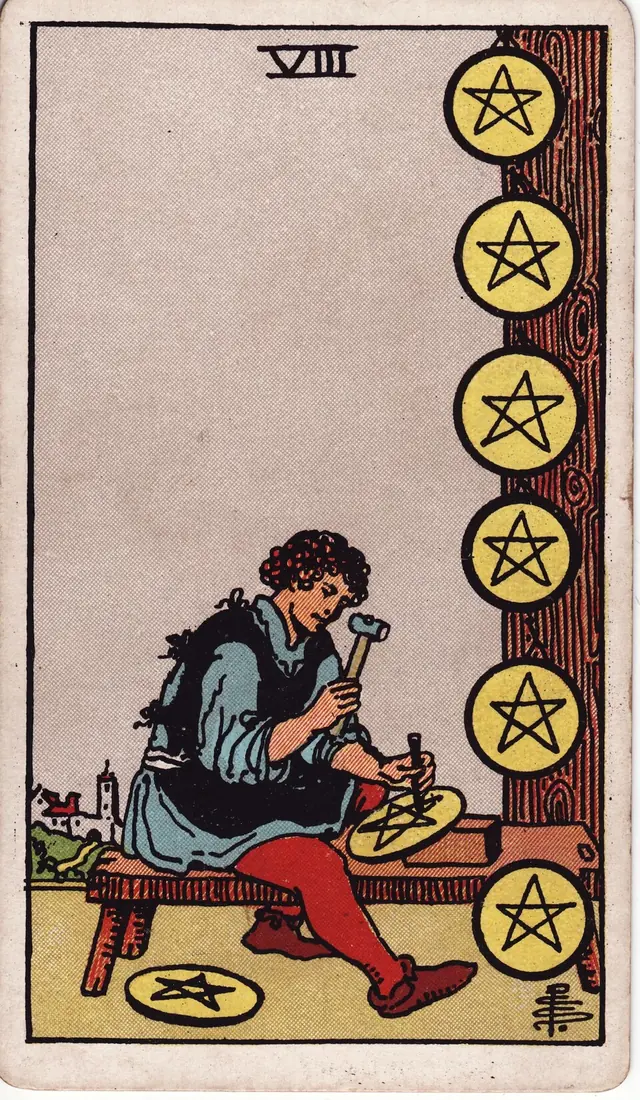
- Upright
- diligence · mastery · practice
- Reversed
- routine · perfectionism
Practice makes perfect.
Meaning
The Eight of Pentacles is the card of practice. After the interim review of the Seven, the work resumes, but differently: not in one grand stroke, but piece by piece, with attention to detail. Among the Pentacles, the Eight stands for diligence, repetition and the slow growth of skill in the element of Earth, where nothing comes about without handiwork.
The card describes phases in which you learn or deepen something: a training course, a new tool, an instrument, a language, a profession. Patiently improving a skill you already have belongs here too. The person on the card is not a master taking a rest, but someone who has finished seven coins, is working on the eighth and knows that the next one will follow. There is a quiet contentment in this attitude that comes from the doing itself, not from applause.
The Eight of Pentacles invites you to appreciate the value of repetition. Not every piece of work has to be exciting to move you forward. Ask yourself which skill you want to develop right now, and whether you give it the regular time it needs. The town in the background comes later. Right now, it is the coin on the workbench that matters.
Advice: Stick with it; every piece counts.
Reversed
Reversed, the work loses its meaning. Practice turns into routine without attention, care turns into perfectionism that is never finished. The card can show that you are getting lost in details and losing sight of the goal, or that you are honing a skill that no longer really interests you. Sloppiness belongs here too: work that is merely ticked off leaves no clean coin behind. And work without a break turns diligence into exhaustion.
Turned inwards, the reversed Eight often describes the feeling of never being good enough, no matter how many coins are already hanging on the post. Ask yourself whether you are learning right now or merely proving yourself.
Love and relationships
In love, the Eight of Pentacles shows that relationships are work in the best sense: attention in everyday life, small gestures, the willingness to listen afresh again and again. In a partnership, it invites you to work on concrete things instead of waiting for grand feelings. If you are single, it can mean that you are busy with yourself and with learning right now; closeness then often comes about along the way, through doing things together.
Work and money
At work, the Eight of Pentacles stands for further training, detailed work and growing skill. It suits times when you are working your way into a new field or deliberately refining an existing skill. Where money is concerned, it is about income that comes from quality and reliability, not from quick deals. Only you can decide which training or specialisation suits you; the card encourages you to stick with it once you have chosen.
As the card of the day
As the card of the day, the Eight of Pentacles recommends a day of focused work. Take on one task and finish it carefully instead of jumping between five things. Switch off distractions; the town in the background can wait too. If you are learning something, practise one small unit mindfully today. In the evening, look at what you have achieved, and hang the coin on the post.
The image
A young craftsman with reddish-brown curls sits on a plain wooden bench. He wears a blue tunic, a dark leather apron and red hose, and bends over his work in concentration: in one hand he holds a hammer, with the other he sets the chisel against a golden coin into which he is striking a pentagram. On the right, six finished coins hang vertically on a reddish-brown wooden post, carefully placed one above the other. Another lies on the ground at the bottom left, in front of the bench. Far back on the left, small and pale, a town with a tower can be seen on a green hill. The sky is empty, the ground yellow. The town is far away, and that is intentional: here someone is working undisturbed and repeating the same movement until he has it down. The row of coins shows that practice leaves visible traces.
Questions for you
- Which skill do I want to develop right now, and do I give it time regularly?
- Am I working with attention, or just going through the motions?
- How do I know that something is good enough, and when am I only polishing away out of fear?