The Hierophant
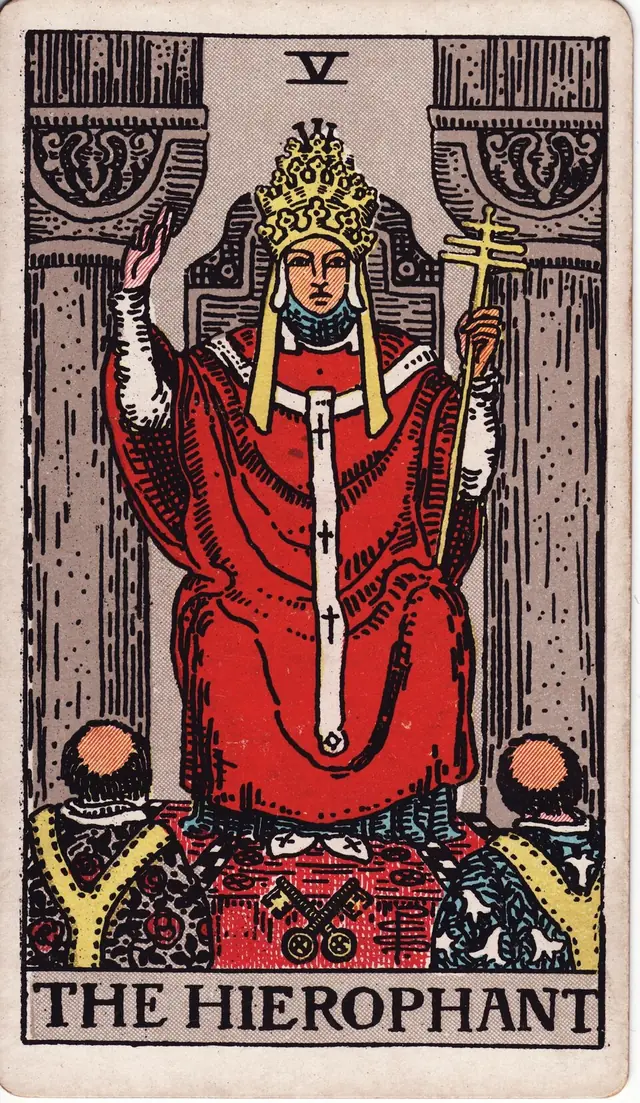
- Upright
- tradition · teaching · values
- Reversed
- dogma · rebellion · breaking with convention
Values, tradition and what connects people.
Meaning
The Hierophant stands for forms that have been handed down: teaching, tradition, rituals, communities with shared values. He shows you the worth of what others found out before you, and the relief of not having to reinvent every wheel yourself. At the same time he reminds you of the price: whoever joins a system also takes on its rules.
In everyday life he appears when training, study or mentoring play a part, when you join a group or move within an institution, be it a school, a church, a club or a company. He also shows up at ceremonies and binding steps, such as a wedding, a christening or an oath, and whenever you seek advice from someone who has more experience than you. The two monks before him show that learning is a relationship: someone gives, someone receives.
The card invites you to clarify your relationship with rules and tradition. Which values do you hold because they were handed to you, and which because you have examined them? Both are legitimate, but it is worth knowing the difference. The Hierophant shows that belonging gives you something to hold on to, and that you can decide for yourself how much form you need. Ask yourself whom you want to learn from right now and what you will one day pass on yourself.
Advice: Learn from those who walked the path before you, then choose your own.
Reversed
Reversed, tradition turns into dogma. Rules are followed because they are rules, not because they make sense; authorities demand obedience instead of understanding, and anyone who asks questions is treated as a disturbance. Perhaps you are experiencing this in an institution, a family or a belief system that has shaped you. But the reversed card also shows the opposite impulse: rebellion for its own sake, rejecting every form simply because it comes from outside. Neither is free.
Ask yourself which convictions you have never examined and which you may have thrown overboard too quickly. The reversed Hierophant invites you to step out of the either-or: you may keep the traditions that support you and let go of those that keep you small. Your conscience is the authority, not the throne.
Love and relationships
In love, the Hierophant stands for commitment, shared values and often for a public bond: an engagement, a wedding, being introduced to the family. If you’re single, he shows that you long for a relationship that rests on shared convictions, and that meeting someone through communities, courses or traditions is especially likely at the moment. In a relationship, he invites the two of you to talk about what matters to you at heart. Make sure that convention doesn’t take the place of genuine agreement.
Work and money
At work, the Hierophant points to training, further education, mentoring and working within established structures. He advises you to ask experienced people for advice, to respect proven procedures and to acquire specialist knowledge thoroughly before you break rules. He suits professions in teaching, consulting and administration and any field with clear standards. With money, he recommends transparent, tried-and-tested paths and is wary of promises that claim to override all previous experience. The decision is yours.
As the card of the day
Today, seek advice from someone who can do something you want to learn, or pass on your own knowledge. Pay attention to the small rituals that give your day something to hold on to, and with one rule you follow, ask yourself whether you understand it. The Hierophant invites you to see tradition as an offer, not as a command.
The image
Between two grey stone pillars sits an enthroned figure in a red robe, wearing a triple golden crown, the papal tiara. A white stole with three crosses runs down the chest; the left hand holds a golden staff with a triple crossbar, and the right hand is raised in blessing, two fingers extended, two bent. Shoes marked with crosses peek out from under the hem. Before the throne kneel two tonsured monks, seen from behind; one wears a robe patterned with red roses, the other one with white lilies. Between them, on the red carpet, lie two crossed golden keys. The pillars stand for the institution, the keys for knowledge that can be passed on but also locked away.
Questions for you
- Which values have I adopted without ever examining them?
- Who am I learning from at the moment, and what do I pass on myself?
- Where does belonging give me support, and where does it hem me in?