Justice
- Upright
- balance · truth · consequence
- Reversed
- unfairness · self-deception · dodging responsibility
See clearly, weigh fairly, take responsibility.
Meaning
Justice asks a simple question: what is really true, and what follows from it? She is the card of the sober view that neither glosses over nor dramatises. When she turns up in your reading, the theme is cause and effect, responsibility and the balance between what you give and what you expect.
Typical situations are those in which a decision is due that you should not make on gut feeling alone: a contract, an agreement, a dispute that needs settling, a question of guilt and making amends. The card shows you that you can see both sides now if you take the time. It also stands for moments when the consequences of earlier decisions become visible, for better or for worse. That is not a verdict on you but a sum that adds up.
Justice invites you to be honest with yourself before you demand honesty from others. Ask yourself what part you play in the situation and what a fair settlement would be. The sword in her hand also means that clarity sometimes cuts: a clear decision has its price, but it puts an end to the dithering. Whoever works with this card gains solid ground underfoot, because they know what they stand for.
Advice: Decide with a cool head and stand by the consequences.
Reversed
Reversed, the scales start to wobble. The card then points to situations in which something unfair is going on: you are being treated unjustly, or you yourself are not quite honest and arrange things the way that suits you. Often there is avoidance behind it. Responsibility gets passed on, a mistake goes unadmitted, an overdue decision is postponed because every option comes at a cost.
Reversed Justice can also go too far: you judge yourself or others harshly, measure with double standards or lose yourself in always having to be right. Ask yourself where you are looking away right now, and whether your strictness really serves the truth or only your own protection. Being honest with yourself brings the scales back into balance.
Love and relationships
In matters of love, Justice shows that fairness and honesty count for more right now than grand gestures. In a relationship it is worth checking whether giving and taking are in balance and whether both of you say openly what you need. Unspoken scores to settle poison a relationship faster than any quarrel. If you are single, the card invites you to look with a clear head instead of talking yourself into someone, and to be just as sincere with yourself as you are with others.
Work and money
At work, Justice stands for contracts, negotiations, appraisals and all decisions where care comes before speed. Read the small print, put agreements in writing and make sure you weigh up effort and return realistically. In money matters, the card advises order and a clear overview: look at the figures instead of hoping. It is not financial advice, but a hint that you carry the responsibility for your decisions yourself and should make them well prepared.
As the card of the day
As your card of the day, Justice invites you to gloss over nothing today. Make a decision you have been putting off, and make it with all the facts on the table. Check where you are being fair today and where you might be measuring with double standards. A clearing-the-air conversation or an honest look at your own figures suits this day well.
The image
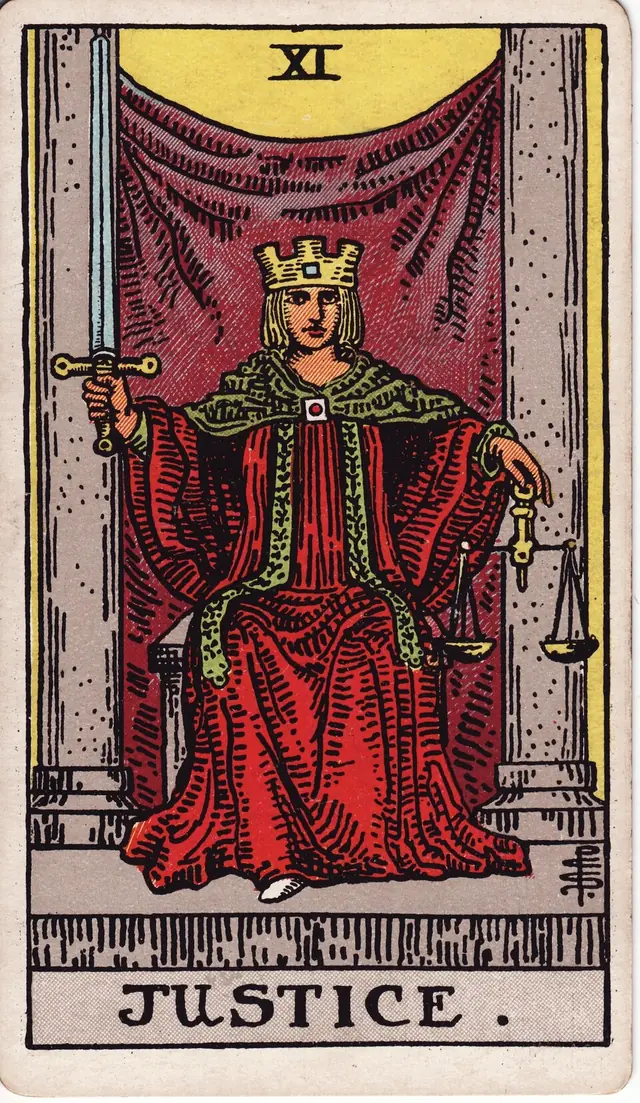
On card XI of the Waite-Smith tarot, a crowned figure sits facing straight ahead on a stone throne between two grey pillars. Behind her hangs a deep purple curtain, and above it the sky glows yellow. She wears a red robe and a green cloak, held together by a clasp set with a red stone. In her right hand she holds a sword raised upright, in her left a pair of golden scales whose pans hang calmly in balance. A white shoe peeks out from under her hem. Justice wears no blindfold; she looks straight at you. The sword stands for clear discernment and for consequences, the scales for careful weighing, the pillars for a firm framework of rules. The curtain hints that there is more behind every decision than meets the eye at first glance.
Questions for you
- Where am I avoiding a clear decision right now, and what is the hesitation costing me?
- What part do I play in the situation I am complaining about?
- What would be a fair settlement that both sides can live with?