Death
- Upright
- ending · transformation · new beginning
- Reversed
- clinging · fear of change · stagnation
Something ends so that something else can begin.
Meaning
When this card comes up, many people get a fright. That is understandable, and you do not have to talk the shock away. Yet Death in the Waite-Smith tarot almost never means a person dying. It stands for an ending that is final and, precisely for that reason, makes room. A phase of life comes to a close, a role you have played for a long time no longer fits, a relationship or a self-image dissolves.
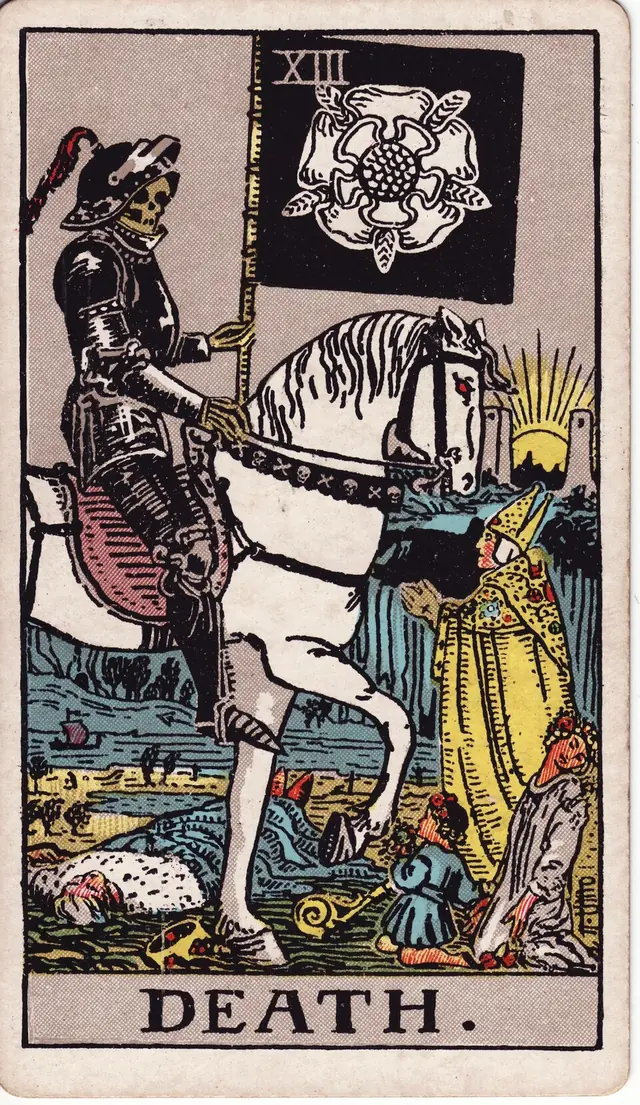
Typical are upheavals you can sense yourself, even if you have not put them into words yet: you know things cannot go on like this and are still waiting for the courage or the occasion. Sometimes the change comes from outside and strikes you as the rider strikes the king. The card shows that the transition is inevitable, but it also shows the child looking on without fear, and the sun on the horizon. What dies is usually something that has not been truly alive for quite some time.
Death invites you to let the ending really end, instead of prolonging it artificially. Grief is part of it, and it may take its time. Ask yourself what in your life has long been finished and is only being carried along out of habit. Whoever lets go discovers that there is an astonishing amount of space beyond the farewell, and that the new is often already waiting before the old has fully disappeared.
Advice: Let go of what has come to an end.
Reversed
Reversed, Death points to a clinging on that costs you more strength than you realise. A change is overdue, but you keep putting it off, staying in a hollowed-out situation or keeping a relationship, a job or a role artificially alive. Fear of what comes afterwards seems greater than dissatisfaction with what is. This does not make the transition easier, only more drawn out.
Sometimes the reversed card also points to a transformation that is already quietly under way and that you have not yet admitted to yourself. Ask yourself what you are actually protecting yourself from when you hold on to the old, and whether it is worth that price. The rider waits patiently, but he does not turn back.
Love and relationships
In love, Death marks the end of a phase. That can be a break-up, but it does not have to be: often an old form of the relationship dies so that a more honest one can emerge, for example when roles shift or an illusion about the other person falls away. In a relationship it is worth asking what between you has long been over and what you want to make of that. If you are single, the card invites you to say a final goodbye to an old hurt or a past relationship before you can truly open up anew.
Work and money
At work, Death stands for the end of a project, leaving a job or a far-reaching change of role. Perhaps you find that a business model, a way of working or a collaboration is coming to its natural end. The card advises you to draw the line consciously and wrap up the past properly, rather than dragging half-finished things along with you. In money matters it can mean that a source of income is drying up and a new one needs to be found. Taking responsibility yourself and looking soberly at the situation matter more here than slogans about sticking it out.
As the card of the day
As your card of the day, Death asks what you can bring to an end today. Clear out something that has been weighing on you for a long time, close a chapter, cancel an appointment that no longer suits you. It does not have to be anything big. Notice how much lighter it feels when something is allowed to be truly over.
The image
A skeleton in black armour rides across the picture on a white horse. A red plume bobs on its helmet, and in its hand it carries a black banner bearing a white rose. The bridle is decorated with small skulls. A king lies on the ground, his golden crown beside him in the grass. On the right stands a bishop in a yellow robe with his hands raised; in front of him kneel a woman, who turns her face away, and a child, who looks towards the rider with curiosity. In the background a boat travels along a river, and between two towers the sun stands low in the sky. No one escapes the rider, as the fallen king shows. The white rose on a black ground and the sun on the horizon say that this is about cleansing and a new beginning, not the end of everything.
Questions for you
- What in my life has long been over, and I am only carrying it along out of habit?
- What am I protecting myself from when I hold on to the old?
- What space would I gain if I truly allowed this farewell?